AS Physics
Practical Equipment
| Apparatus | Resolution |
|---|---|
| Meter rule | 1mm |
| Vernier calipers | 0.05mm |
| Micrometer screw gauge | 1µm |
Momentum
The product of mass and velocity.
\(p = mv\)
The Principle of Conservation of Momentum
The total linear momentum before a collision is equal to the total linear momentum after a collision unless the system is acted on by a resultant external force
Force
The rate of change of momentum
\(F = \dfrac{\Delta p}{\Delta t}\)
Collisions
Elastic Collisions
The collision in which the total kinetic energy of the system is conserved
- The relative speed of approach = the relative speed of separation
Inelastic Collisions
The collision in which the total kinetic energy is not conserved
- Occurs when objects crumple and deform
Center of Gravity
The point at which the weight of the object may be considered to act
Moment
The turning effect of a force
\(moment = Fd\)
Couple
A pair of forces that acts to produce rotation only
- Equal in magnitude
- Opposite in direction
- Perpendicular to the distance between them
Torque
The moment of a couple
\(\tau = Fd\)
The Principle of Moments
For a system to be in equilibrium, the sum of clockwise moments about a point must be equal to the sum of the anticlockwise moments (about the same point)
Archimedes' Principle
An object submerged in a fluid at rest has an upward buoyancy force (upthrust) equal to the weight of the fluid displaced by the object
\(F = \rho g V\)
Energy
The Principle of Conservation of Energy
Energy cannot be created or destroyed, it can only transferred from one energy store to another
Gravitational Energy
Energy stored in a mass due to its position in a uniform gravitational field
Kinetic Energy
Energy an object has due to its motion
Deformation
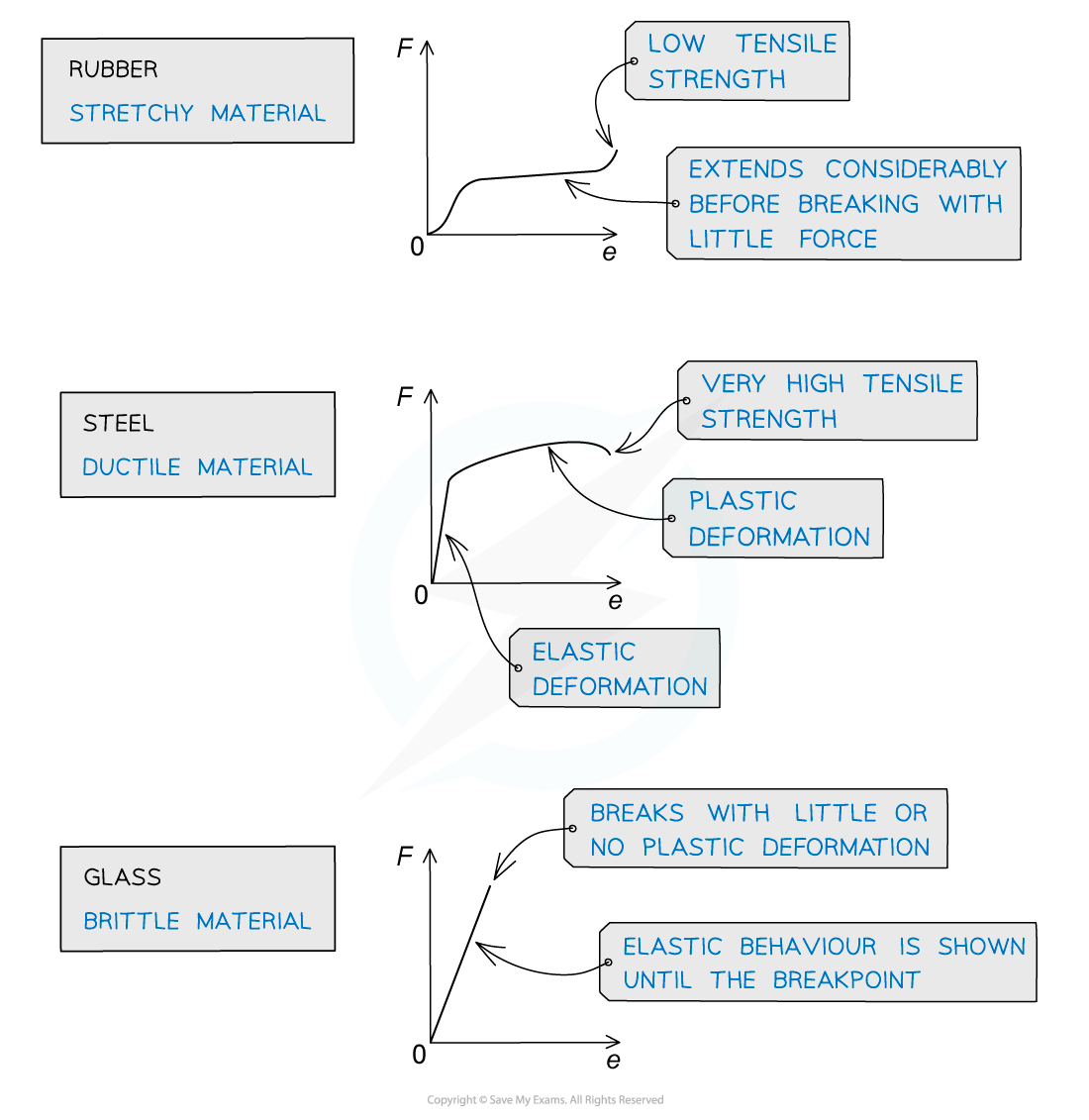
Hooke's Law
Extension is directly proportional to the applied force
\(F = kx\)
The Spring Constant
A measure of the stiffness of a spring
\(k = \dfrac FX\)
Stress
Applied force per unit cross sectional area
- The ultimate tensile stress is the maximum tensile stress before breaking
\(\sigma = \dfrac FA\)
Strain
Extension per unit length
\(\epsilon = \dfrac XL\)
Young Modulus
The ratio of stress and strain
- A measure of how stiff or elastic a material
\(E = \dfrac \sigma \epsilon = \dfrac{FL}{Ax}\)
Wave
The Wave Equation
\(v = f \lambda\)
Wave Intensity
\(I = \dfrac PA\)
\(I \propto A^2\)
\(I \propto f^2\)
Progressive Waves
Waves that transfer energy without transfer of matter
Transverse Waves
A wave in which the particles oscillate perpendicular to the direction of motion and energy
- Peaks and troughs
- Electromagnetic waves, visible light, UV, vibrations on strings
- Can be polarized
Longitudinal Waves
A wave in which the particles oscillate parallel to the direction of motion and energy transfer
- A rarefaction is an area of low pressure, with the particles being further apart from each other
- A compression is an area of high pressure, with the particles being closer to each other
- Cannot travel through a vacuum
- Sound waves
Doppler Effect
\(f_o = f_s (\dfrac{v}{v \pm v_S})\)
- \(v\): wave velocity
-
\(v_s\): velocity of the source relative to the observer
-
Source moving towards: \(v - v_s\)
-
Source moving away: \(v + v_s\)
-
Source is moving
- Observer is stationary
Electromagnetic Spectrum
| Radiation | Wavelength/m |
|---|---|
| Gamma Rays | 1e-16, 4e-13 |
| X Rays | 4e-13, 1e-8 |
| Ultraviolet | 1e-8, 4e-7 |
| Visible | 4e-7, 7e-7 |
| Infrared | 7e-7, 1e-3 |
| Microwaves | 1e-3, 1e-1 |
| Radio | 1e-1, \(\infty\) |
- Memorization:
- 1 4 1 4 7 1 1
- 6 3 8 7 7 3 1
Malus's Law
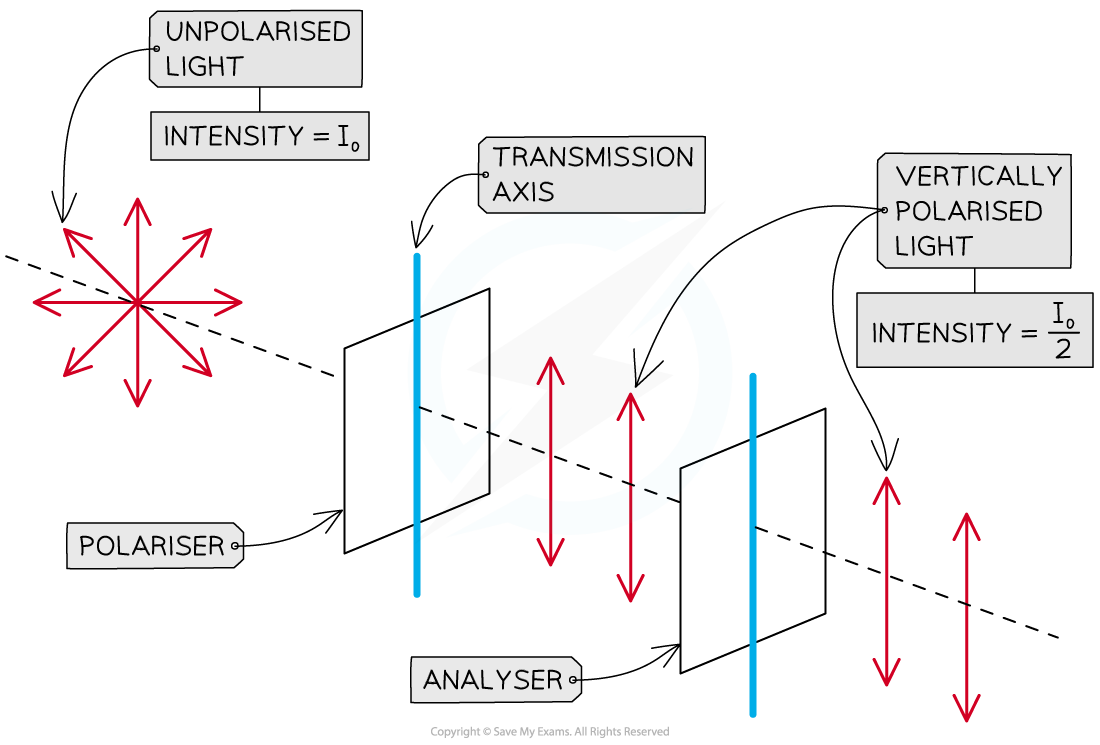
If unpolarized electromagnetic waves of intensity \(I_0\) pass through a polarizer, the intensity of the transmitted polarized waves falls by a half
\(I = \dfrac{I_0}2\)
If the analyzer is rotated by an angle θ with respect to the polarizer, the intensity of the waves transmitted by the analyzer is given by the equation
\(I = I_0 \cos^2(\theta)\)
Superposition
The Principle of Superposition
When two or more waves overlap at a point, the displacement at that point is equal to the sum of the displacements of the individual waves
Wavelength of Stationary Waves
Waves that do not transfer energy and matter
Fundamental Mode of Vibration / First Harmonic
The simplest wave pattern of a wave fixed at both ends is a single loop made up two nodes and an antinode.
- Nodes are locations of zero amplitude
- Antinodes are locations of maximum amplitude
Zero Open Ends
\(L = \dfrac{n \lambda}2, n \in [1, 3]\)
One Open End
\(L = \dfrac{n \lambda}{4}, n\ is\ odd\)
Two Open Ends
\(L = \dfrac{n \lambda}2, n \in \mathbb{N}^*\)
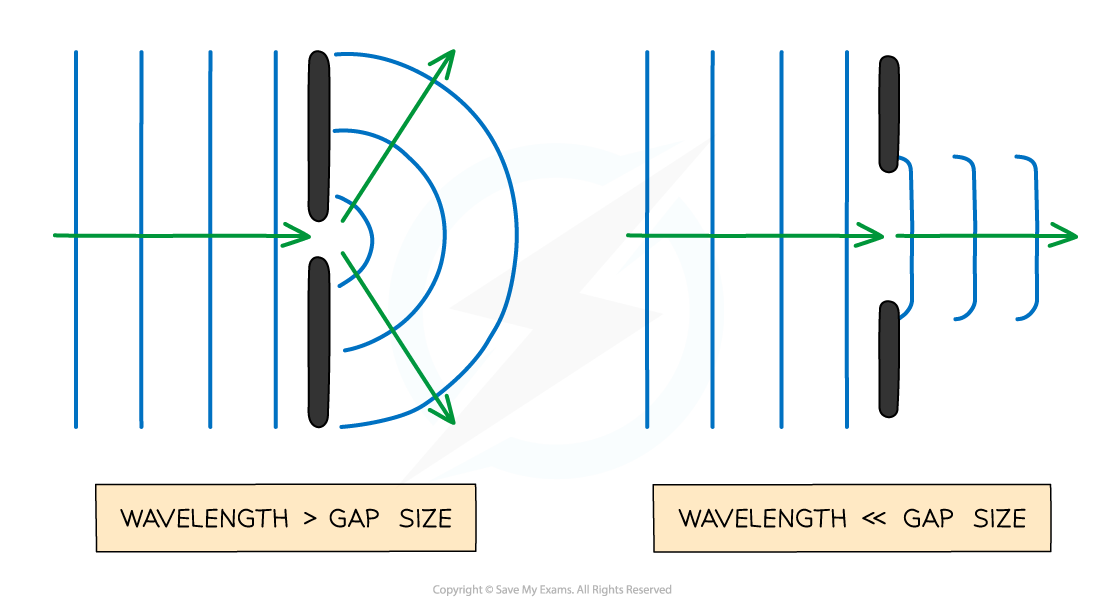
Diffraction
The spreading out of waves when they pass an obstruction
Conditions for Constructive & Destructive Interference
- Constructive interference: path difference = \(n \lambda, n \in \mathbb{N}\)
- Destructive interference: path difference = \((n+\dfrac12) \lambda, n \in \mathbb{N}\)
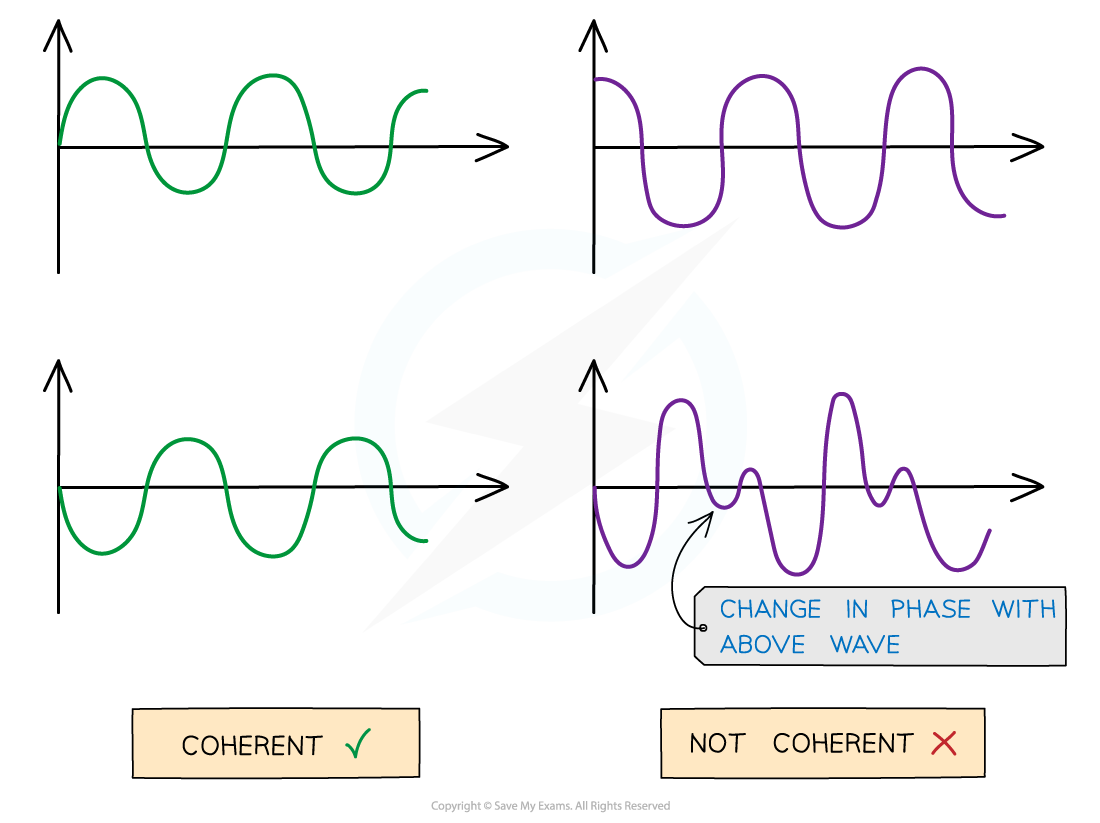
Coherence
Waves have the same frequency and constant phase difference
Double Slit
\(\lambda = \dfrac{ax}D\)
- \(\lambda\): wave length of source
- \(a\): distance between the centers of the slit
- \(x\): fringe width (distance between successive bright fringes)
- \(D\): distance between the slits and the screen
The Diffraction Grating
\(d \sin(\theta) = n \lambda\)
- \(d\): spacing between adjacent silts
- \(\theta\): angular separation between the order of maxima
- \(n \in \mathbb{N}\): order or maxima
- \(\lambda\): wavelength of source
To calculate the orders of maxima, \(\theta = 90^\circ, \sin(\theta) = 1\)
Silt Spacing
Diffraction gratings come in different sizes measured by lines/m, represented by \(N\)
\(d = \dfrac1N\)