The Normal Distribution
Properties of Normal Distributions
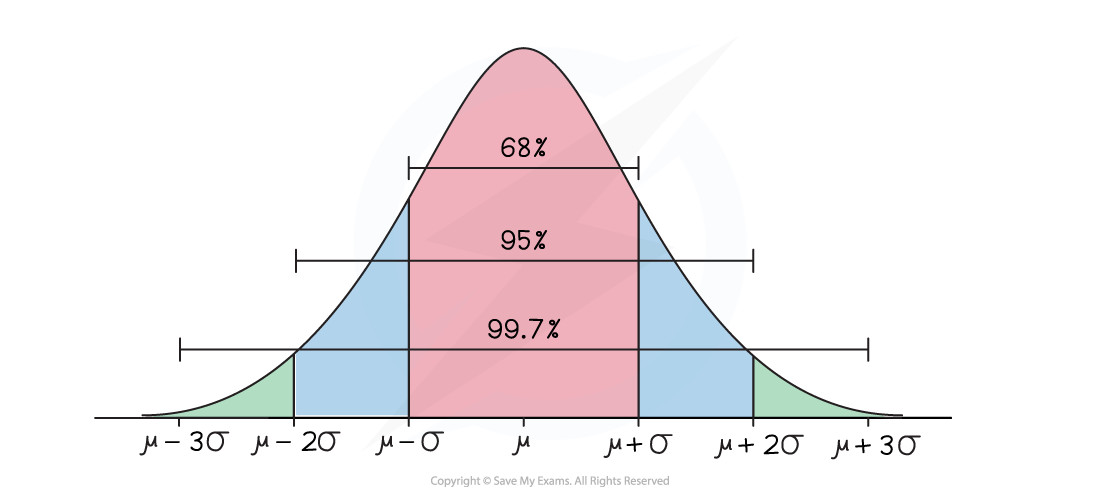
Empirical Rules
- 68% of the data lies within one standard deviation of the mean \((\mu \pm \sigma)\)
- 95% of the data lies within two standard deviations of the mean \((\mu \pm 2 \sigma)\)
- 99.7% of the data lies within three standard deviations of the mean \((\mu \pm 3 \sigma)\)
What Can Be Modeled Using A Normal Distribution
- The variable is roughly symmetrical with only one mode
- X can take any real value
- Values far from the mean (more than 4 standard deviations away) have a probability density of practically zero
What Cannot Be Modeled Using A Normal Distribution
- More than one mode or no mode
- Not symmetrical
- Variables in which acceptable ranges of values (\(\mu \pm 3 \sigma\)) become negative when they are meant to be positive
Standardized Z-Scores
- Standard Normal Distribution: a normal distribution where mean is 0 and standard deviation is 1. Denoted by \(Z\).
- Any normal distribution can be transformed to the standard normal distribution curve by a horizontal translation and a horizontal stretch
- \(Z = \frac{X - \mu}{\sigma}\), where \(X\) is a normal distribution with mean \(\mu\) and standard deviation \(\sigma\)
- Standard Normal Table: z-score → possibility
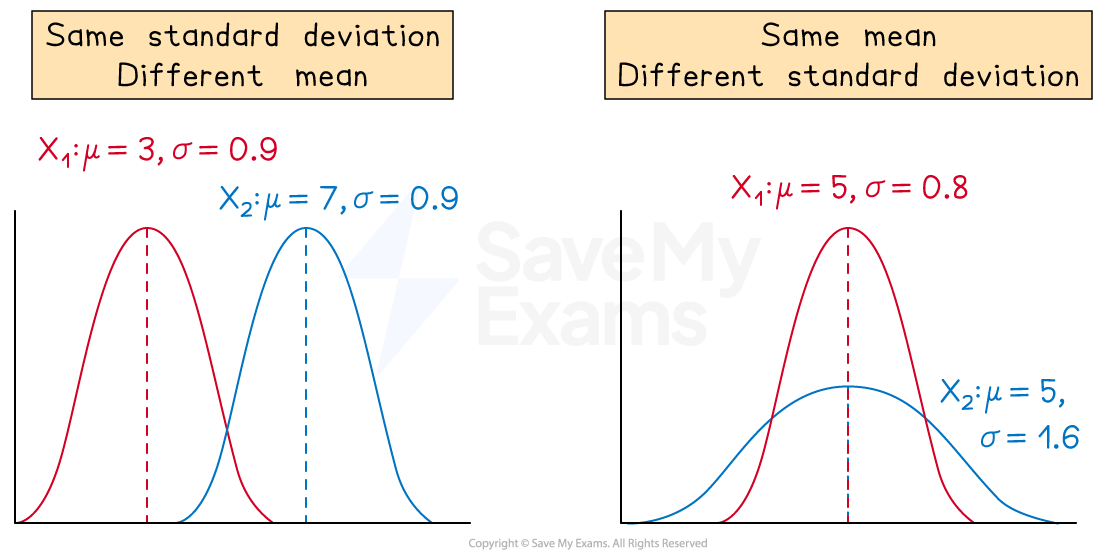
Comparing Normal Distributions
Two can be compared by examinating their \(\mu\) and \(\sigma\)
Comparing \(Z\)-Scores
- \(Z\)-score indicates the number of \(\sigma\) that a data lies from the \(\mu\) of its distribution
- The data point with greater \(z\)-score lies furthur from the \(\mu\)
Inverse Normal Calculations
P(X < a) \(\rightarrow\) value
- Find the cell in the standard normal table \(\leq\) P(X<a)
- Get z-score
- Convert z-score back to the actual value
P(X > b) \(\rightarrow\) value
- Get P(X < b) = 1 - P(X > b)
- Find the cell in the standard normal table \(\geq\) P(X > b)
- Get z-score
- Convert z-score back to the actual value
Notice, when getting the cell, choose the one that is closest while within the limit.