Inference for Means
t-Distribution
What Is t-Distribution
A continuous probability distribution similar to the normal distribution
- The tails are thicker \(\implies\) more chances of getting extreme values
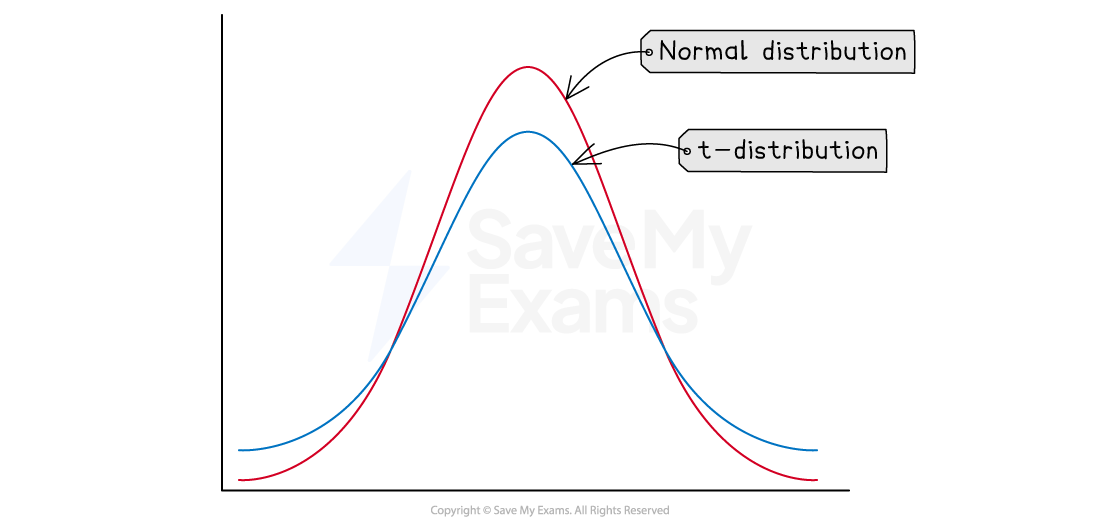
- Degrees of freedom, dof
- \(\uparrow\) dof \(\implies\) peak sharper and tails thinner \(\implies\) closer to normal distribution
- \(\mu = 0\)
- \(\sigma > 1\), closer to 1 as dof increases
When Is t-Distribution Used
- \(\sigma\) is unknown and population is approximately normally distributed
- \(n < 30\)
- t-distribution can be used to
- Perform hypothesis tests for \(\mu\)
- Form confidence intervals for \(\mu\)
Hypothesis Tests for Population Means
One-Sample t-test for Mean
Test whether the population mean of a normally distributed population has changed
\(\sigma\) is unknown
Conditions for One-Sample t-test
- If the population is very skewed, a t-test can only be done when \(n \geq 30\)
Calculate t-value
- \(t = \dfrac{\overline{x} - \mu}{standard\ error}\)
- \(standard\ error = \dfrac{s}{\sqrt{n}}\)
Calculate dof
- \(dof = n-1\), if there are multiple \(n\), choose the smallest one.
For Differences in Population
- \(standard\ error = \sqrt{\dfrac{s_A^2}{n_A} + \dfrac{s_B^2}{n_B}}\)
t-scores VS z-scores
graph LR;

H(Start);
I{Normally distributed?};
H --> I;
I -->|Yes| G;
I -->|No| F;
G{Population variance known?};
G -->|Yes| B(z-score);
G -->|No| C{n < 30?};
C -->|Yes| D(t-score);
C -->|No| B;

F{n ≥ 30?} -->|"Yes (CLT)"| B;
F -->|No| J(Non-parametric tests);
Paired t-test
Test whether or not the population means of two pieces of data that are linked are equal by examining the differences between paired data
- The data for a two-sample t-test is from two independent populations
-
The data for a paired t-test is linked and come from one population
-
Use \(d\) for the difference of two measures. For instance, \(\mu_d\)
Calculate t-value
\(t = \dfrac{\overline{x_d} - \mu_d}{\frac{s_d}{\sqrt{n}}}\)