Demand and supply
Supply Curve
Determinants of Supply
The supply curve illustrates how the quantity supplied responds to changes in various factors. Below is a breakdown of the determinants:
| Determinants | Effect on Curve |
|---|---|
| Price | Move along curve (no shift) |
| Input price | Shift curve |
| Technology | Shift curve |
| Expectations | Shift curve |
| Number of sellers | Shift curve |
Note
When price decreases while income remains constant, consumers' purchasing power increases.
Elasticity Concepts
Price Elasticity of Demand (PED)
Formula:
PED = \frac{\Delta \text{Quantity Demanded\%}}{\Delta \text{Price\%}} $$ $$ PED \in [0, +\infty)Types of Price Elasticity of Demand
-
Perfectly Elastic Demand : The demand curve is a horizontal line.
-
Relatively Elastic Demand
: Percentage change in quantity demanded exceeds percentage change in price (). -
Unit Elastic Demand
: Percentage change in quantity demanded equals percentage change in price (). -
Relatively Inelastic Demand
: Percentage change in quantity demanded is less than percentage change in price (). -
Perfectly Inelastic Demand
: The demand curve is a vertical line.
Total Revenue and Elasticity
2.2 Price Elasticity of Supply (PES)
Formula:
PES = \frac{\Delta \text{Quantity Supplied\%}}{\Delta \text{Price\%}} $$ $$ PES \in [0, +\infty)Simple Formula
Mid-Point Formula
Types of Price Elasticity of Supply
-
Perfectly Elastic Supply
: The supply curve is a horizontal line. -
Relatively Elastic Supply
: Percentage change in quantity supplied exceeds percentage change in price (). -
Unit Elastic Supply
: Percentage change in quantity supplied equals percentage change in price (). -
Relatively Inelastic Supply
: Percentage change in quantity supplied is less than percentage change in price (). -
Perfectly Inelastic Supply
: The supply curve is a vertical line.
2.3 Income Elasticity of Demand (YED)
Formula**: $$ YED = \frac{\Delta \text{Quantity\%}}{\Delta \text{Income\%}} $$
2.4 Cross-Price Elasticity of Demand (XED)
Formula:
Market Equilibrium
Equilibrium Price
The equilibrium price is the point where the Demand Curve and Supply Curve intersect.
Changes in Supply and Demand
| No Change in Supply | Increase in Supply | Decrease in Supply | |
|---|---|---|---|
| No Change in Demand | , | , | , |
| Increase in Demand | , | , | , |
| Decrease in Demand | , | , | , |
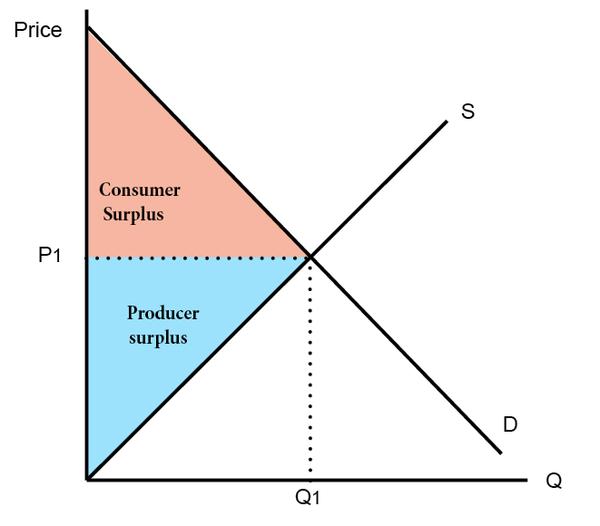
Consumer and Producer Surplus
Consumer Surplus
- Willingness to Pay (WTP): The maximum price a consumer is willing to pay for a good or service.
- Marginal Buyer: The consumer who leaves the market first if the price rises further.
Producer Surplus
- Marginal Seller: The producer who leaves the market first if the price decreases further.
Total Surplus
Government Intervention in Markets
Price Ceiling
- Effective only when actual price > price ceiling.
- Causes a shortage:
$$ \text{Shortage} = QD - QS $$ - Protects consumers.
Price Floor
- Effective only when actual price < price floor.
- Causes a surplus:
$$ \text{Surplus} = QS - QD $$ - Protects producers.
Taxes
- Tax burden depends on elasticity:
$$ \text{Inelastic} \implies \text{Higher tax burden} $$ - Size of tax:
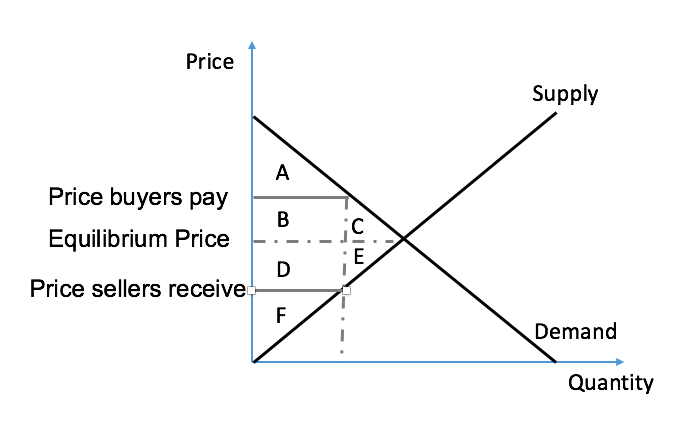
$$ \text{Size of Tax} = \text{Price of Demand} - \text{Price of Supply} $$ - Tax revenue:
$$ \text{Tax Revenue} = T \cdot Q $$
Impact of Taxes on Surplus
| Without Tax | With Tax | Change | |
|---|---|---|---|
| Consumer Surplus | |||
| Producer Surplus | |||
| Tax Revenue | None | ||
| Total Surplus |